The risk of not flexing
By Luke Williams · October 10, 2026 · 4 minute read
Most sales teams spend weeks getting the message right: the call guide, the email sequence, the demo script. Then everyone uses the same version with every prospect.
The message itself may be strong. The problem is who it's written for. A script carries the style of the person who wrote it: their pace, their level of detail, how quickly they get to the point. It works well for prospects who lead with that same style. For everyone else it lands somewhere between slightly off and stressful.
The math of not flexing
StyleFLEX uses four styles: Direct, Spirited, Steady and Precise. Everyone uses all four. What differs is the one you lead with.
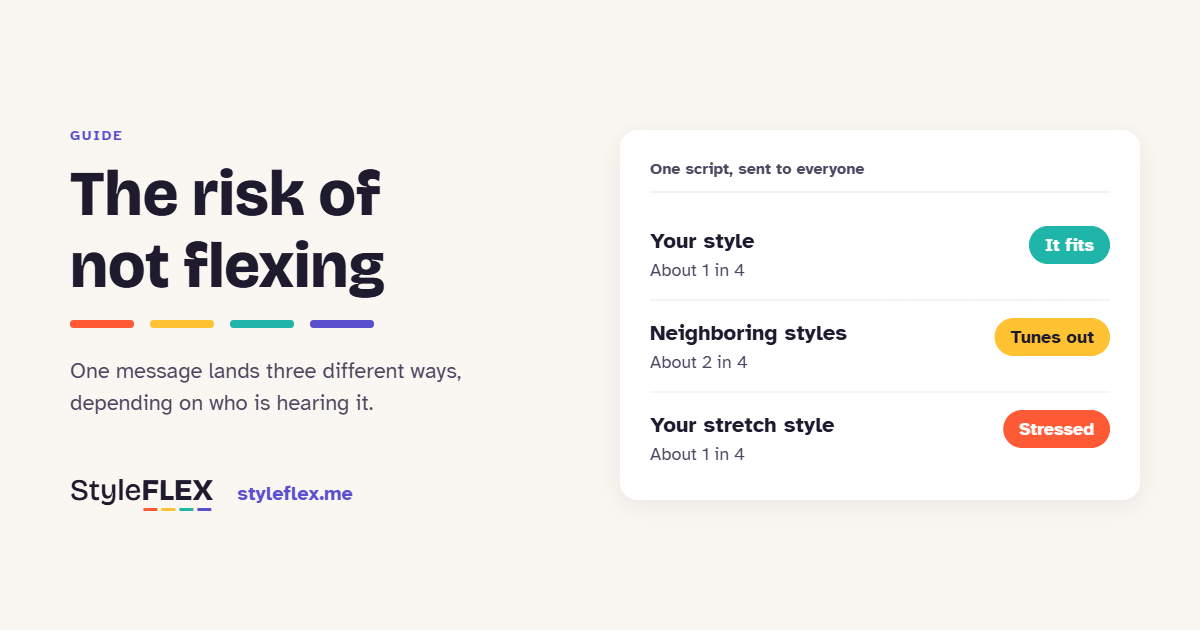
Say your prospects are spread roughly evenly across the four styles. Real mixes vary by industry and role, but it's a useful starting point. If your script is written in one style, here is roughly how it lands:
| Who hears it | Share of prospects | How your one message lands |
|---|---|---|
| People who lead with your style | About 1 in 4 | It fits. The pace, detail and tone feel right. |
| People who lead with the two neighboring styles | About 2 in 4 | It doesn't resonate. Too fast or too slow, too much detail or too little. They get annoyed or stop paying attention. |
| People who lead with your stretch style (the opposite of yours) | About 1 in 4 | It's stressful. Everything they need is missing, and everything they don't want is there. |
Worst case, a single script is stressing about a quarter of the people who hear it, and half are annoyed or tuning out. Only about a quarter hear it the way you meant it.
None of that is about the words or the offer. The message can be exactly right. What misses is the style it's delivered in.
Your stretch style is the one opposite yours. If you lead with Direct, it's Steady: you want speed and a decision, they want time, a plan and to know how it affects people. If you lead with Spirited, it's Precise: you bring energy and the big picture, they want data, details and time to think.
Why scripts drift to one style
Nobody sets out to write for a quarter of the market. It happens because we write the way we'd want to be sold to.
A Direct sales leader writes a call guide that gets to the point in the first ten seconds and asks for a decision. A Precise product marketer writes an email with three proof points, a table and a link to the spec sheet. A Spirited founder writes a pitch full of vision and stories. Each one reads well to the person who wrote it, and to everyone who leads with the same style.
Then the script gets tested, and it works on some calls. The team takes that as proof the script is right. The prospects it didn't reach rarely say why. They go quiet, ask for "more time", or say "not right now".
What flexing a script looks like
Flexing doesn't mean four scripts. Keep the same message, the same offer and the same facts. Change how you open, the pace, the proof you lead with and how you ask for the next step.
| If they lead with | Open with | Pace | Lead with this proof | Ask for the next step by |
|---|---|---|---|---|
| Direct | Why you're calling, in one sentence | Fast; respect the clock | Results and options | Offering two or three options and letting them choose |
| Spirited | Something friendly and personal | Lively; allow tangents | Stories and who else uses it | Painting the outcome and making it easy to say yes |
| Steady | A warm, low-pressure start | Unhurried | Support, guarantees, similar customers | Laying out the steps and offering time and a check-in |
| Precise | A clear agenda, sent ahead | Measured; pause for questions | Data, specs and documentation | Stating clear terms with no pressure, and answering every question |
A call guide built this way has one core message and four short openings. The rep listens for the first minute, makes an assumption about the prospect's style, and adjusts. When the assumption is wrong, the prospect's reactions say so quickly, and the rep shifts again.
How to start
- Know the style you lead with. Your script almost certainly matches it. Once you know it, you know which quarter of your prospects you're already reaching and which quarter you're most likely stressing.
- Write one opening for your stretch style. Take your current call guide or first email and write a version of the first two lines for the style opposite yours. That single change covers the prospects you're most likely losing.
- Listen before you pitch. Use the first minute of a call, or the first reply to an email, to notice how the other person communicates: fast or measured, warm or businesslike, big picture or detail. Then use the opening that fits.
The goal isn't to sound like someone else. It's to make your message easy to take in for the person on the other side, which lowers stress for them and makes a yes more likely.
Closing
One message for everyone feels efficient. It's the same script, the same training and the same email. But if it only gets through cleanly to about one prospect in four, it costs you the other three.
StyleFLEX helps you find the style you lead with, see the styles your customers lead with, and adjust your message so it lands. Take the assessment at styleflex.me.