The risk of not flexing in customer service
By Luke Williams · October 10, 2026 · 4 minute read
A service team runs on consistency: one call flow, one set of saved replies, one quality scorecard. Every rep greets the same way, verifies the same way and says the same empathy line. That makes the work trainable and measurable. It also means every customer hears the same style, no matter how they communicate.
In sales, a mismatch costs you a deal. In customer service, the customer usually reaches you with a problem, so they're already stressed. A response in the wrong style adds to it. That's when you see repeat contacts, escalations, "let me talk to your manager" and low satisfaction scores, even when the rep solved the issue.
The same math, with no time to fix it
StyleFLEX uses four styles: Direct, Spirited, Steady and Precise. Everyone uses all four. What differs is the one you lead with.
Say your callers are spread roughly evenly across the four styles. If your call flow is written in one style and used with everyone, here is roughly how it lands:
| Who hears it | Share of customers | How your call flow lands |
|---|---|---|
| People who lead with the style it was written in | About 1 in 4 | It fits. The call feels easy and the fix feels like enough. |
| People who lead with the two neighboring styles | About 2 in 4 | It doesn't resonate. Too slow or too rushed, too much explaining or too little. They get impatient or stop listening. |
| People who lead with the opposite style | About 1 in 4 | It's stressful. On top of the problem they called about, the call itself becomes another problem. |
An account manager can learn a client's style over months. A rep has about 30 seconds, and then the next customer.
Read the style in the first 30 seconds
You don't need a profile to make a good guess. Listen to how the customer opens the call, or read their first chat or email message.
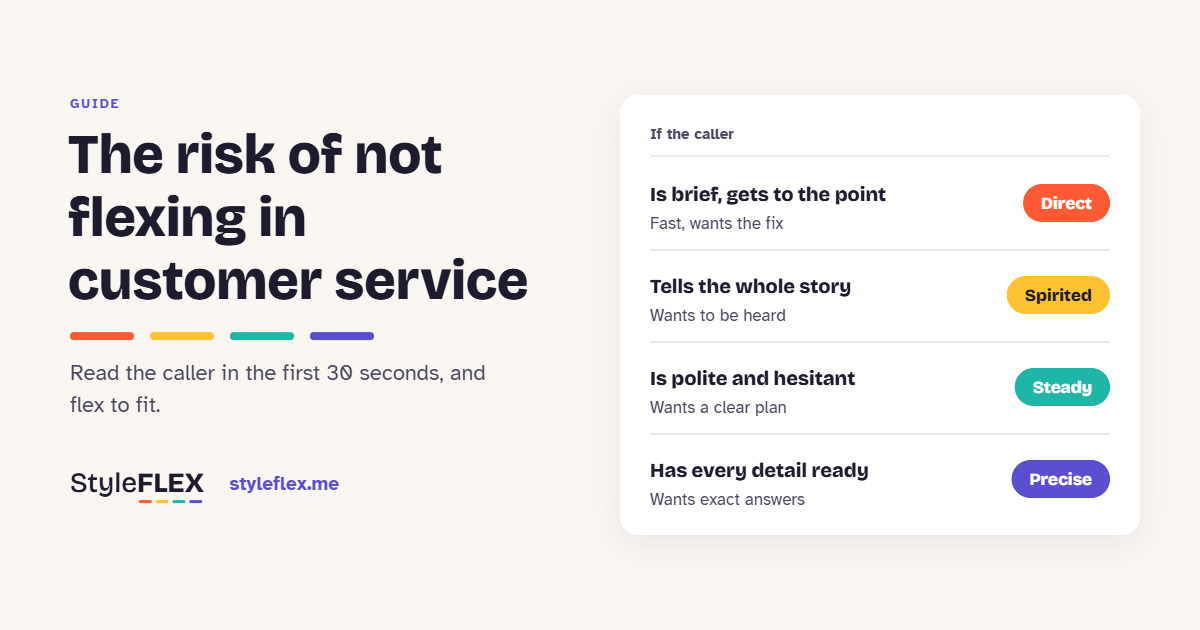
| If the customer | They likely lead with | Flex by | Avoid |
|---|---|---|---|
| Is brief, gets straight to the issue, may interrupt | Direct | Confirming the issue in one sentence, giving the fix or their options, and moving fast | Long apologies, repeating the policy, asking questions you don't need |
| Tells the story, is chatty or emotional, mentions people | Spirited | Letting them talk for a moment, matching their energy, and keeping it friendly | Sounding flat or reading from the screen |
| Is polite, hesitant, apologizes for calling, worries about what happens next | Steady | Slowing down, reassuring them, and walking through each step and what happens after | Rushing, or surprises at the end of the call |
| Has the account number ready, gives exact details, asks precise questions | Precise | Giving exact answers, timelines and reference numbers, and sending it in writing | Guessing, vague answers, or "don't worry about it" |
The resolution, the policy and the facts stay the same. What changes is the pace, how much you explain, and how you close.
What flexing gets you
- Less stress for the customer. They feel heard in the way they need, so the call stops adding to the problem.
- Fewer repeat contacts and escalations. A customer who understood and trusted the answer the first time doesn't call back to hear it again.
- Less stress for the rep. Reps who can read a caller and adjust spend less time on calls that go sideways, which matters in a job with this much volume.
For managers: build flex into the system
- Keep one call flow, add four flex points. The greeting, the explanation, the confirmation and the close each get a short note on how to adjust for each style.
- Change what quality scores reward. Instead of checking that the rep said the exact empathy line, score whether they matched the customer's pace and level of detail.
- Coach with real calls. In call reviews, ask which style the customer led with and what the rep could have adjusted. It's a faster coaching conversation than going line by line.
- Know your team's styles. Reps flex more easily toward styles close to their own. Knowing each rep's stretch style shows who needs practice with which callers.
For reps: start on your next shift
- Know the style you lead with. It's the style you'll slip into when you're tired or busy.
- Listen to the first 30 seconds. Fast or measured, warm or businesslike, story or facts. Make a guess, and adjust if their reactions say you're wrong.
- Practice your stretch style. It's the caller you're most likely to lose. Have one opening and one close ready for them.
The goal isn't to sound different on every call. It's to deliver the same fix in a way that's easy for the customer to take in, which lowers stress on both ends of the line.
Closing
One call flow for every customer is efficient. But if it only fits about one caller in four, the other three leave less satisfied than the fix deserved.
StyleFLEX helps service teams find the style each rep leads with, read the style customers lead with, and adjust so the help lands. Take the assessment at styleflex.me.
Related: The risk of not flexing in sales, The risk of not flexing with key accounts, How to calm an upset customer, by style