The risk of not flexing with key accounts
By Luke Williams · October 10, 2026 · 4 minute read
Once someone becomes a customer, most teams standardize the experience: one onboarding sequence, one check-in agenda, one business review deck, one set of saved support replies. That consistency is good for the process. It's risky for the relationship, because every standard message carries the style of the person who wrote it.
Customers don't go quiet the way prospects do. They stay, for a while. But the ones who feel stressed or tuned out by how you communicate are the ones who skip the check-in, don't open the renewal email, and leave saying "we went another direction."
The same math, with more at stake
StyleFLEX uses four styles: Direct, Spirited, Steady and Precise. Everyone uses all four. What differs is the one you lead with.
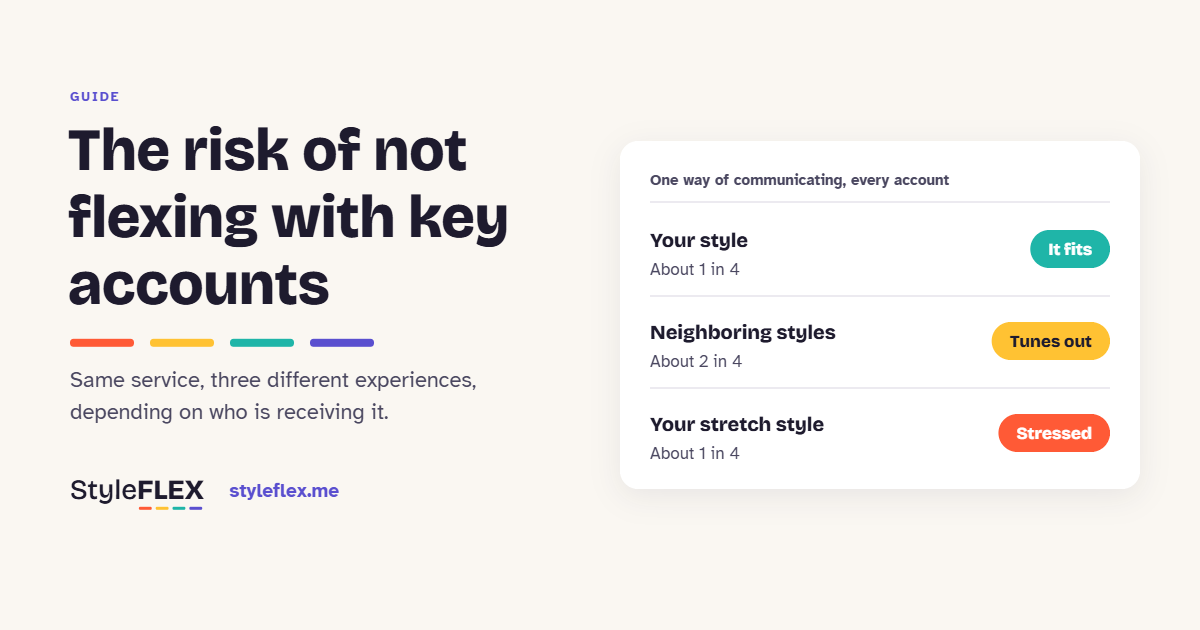
Say your customer contacts are spread roughly evenly across the four styles. If your customer communication is written in one style and sent to everyone, here is roughly how it lands:
| Who hears it | Share of customers | How your one message lands |
|---|---|---|
| People who lead with your style | About 1 in 4 | It fits. They read it, reply and feel looked after. |
| People who lead with the two neighboring styles | About 2 in 4 | It doesn't resonate. They skim it, skip the meeting and engage a little less each quarter. |
| People who lead with your stretch style (the opposite of yours) | About 1 in 4 | It's stressful. They feel rushed, ignored or buried in detail, and start to wonder if you're the right partner. |
With a prospect, a mismatch costs you a deal you didn't have yet. With a customer, it puts revenue you already have at risk, and the people it stresses rarely say so until renewal.
Where one message shows up with customers
- Onboarding. The welcome email and the kickoff call.
- Check-ins and business reviews. The same agenda and the same deck for every account.
- Support. The saved reply for each issue.
- Bad news. Price increases, delays, outages and changes to the product.
- Renewals. The same renewal email and the same timeline.
Bad news is where style matters most. Stress is already high, and a message in the wrong style adds to it.
What flexing with customers looks like
Keep the same facts, the same commitments and the same service. Change how you check in, how you deliver bad news and how you approach the renewal.
| If they lead with | Check-ins | Delivering bad news | The renewal conversation |
|---|---|---|---|
| Direct | Short, results first, and the decisions they need to make | State it plainly up front, then the fix and their options | Results, options and a clear recommendation |
| Spirited | Conversational, wins and what's next | Call rather than email, and stay positive about the path forward | The bigger picture and what you'll do together next year |
| Steady | A consistent schedule, how their team is doing, no surprises | Early warning, a clear plan, and how it affects their people | Plenty of lead time, the steps, and reassurance about support |
| Precise | An agenda sent ahead, with data and accurate details | Exactly what happened, the facts, and the timeline to fix it | Written terms, usage and value data, and time to review |
What flexing gets you
- Less stress for the customer. Each contact gets the pace, detail and reassurance they need, especially when the news is bad.
- More engagement. Customers come to the check-ins, read the updates and use what you've built for them.
- Earlier warnings. When a customer feels understood, they tell you sooner when something isn't working, while you can still fix it.
How to start
- Know the style you lead with. Your welcome email, check-in agenda and saved replies almost certainly match it. Once you know it, you know which customers you're already reaching and which you're most likely stressing.
- Note each key contact's style. Look at how they write and talk: short or detailed, warm or businesslike, fast or measured. Put it where your team will see it before the next interaction.
- Flex the bad news first. Before your next price increase, delay update or renewal email goes out, write the first two lines a second way, for the style opposite yours.
The goal isn't to treat customers differently. It's to deliver the same service in a way that's easy to take in for the person on the other side, which lowers stress for them and makes the next renewal easier.
Closing
Consistency in what you deliver builds trust. Consistency in how you communicate it reaches about one customer in four.
StyleFLEX helps you find the style you lead with, see the styles your customers lead with, and adjust how you communicate so it lands. Take the assessment at styleflex.me.
Related: The risk of not flexing in sales, The risk of not flexing in customer service, How to calm an upset customer, by style