How to calm an upset customer, by style
By Luke Williams · October 10, 2026 · 3 minute read
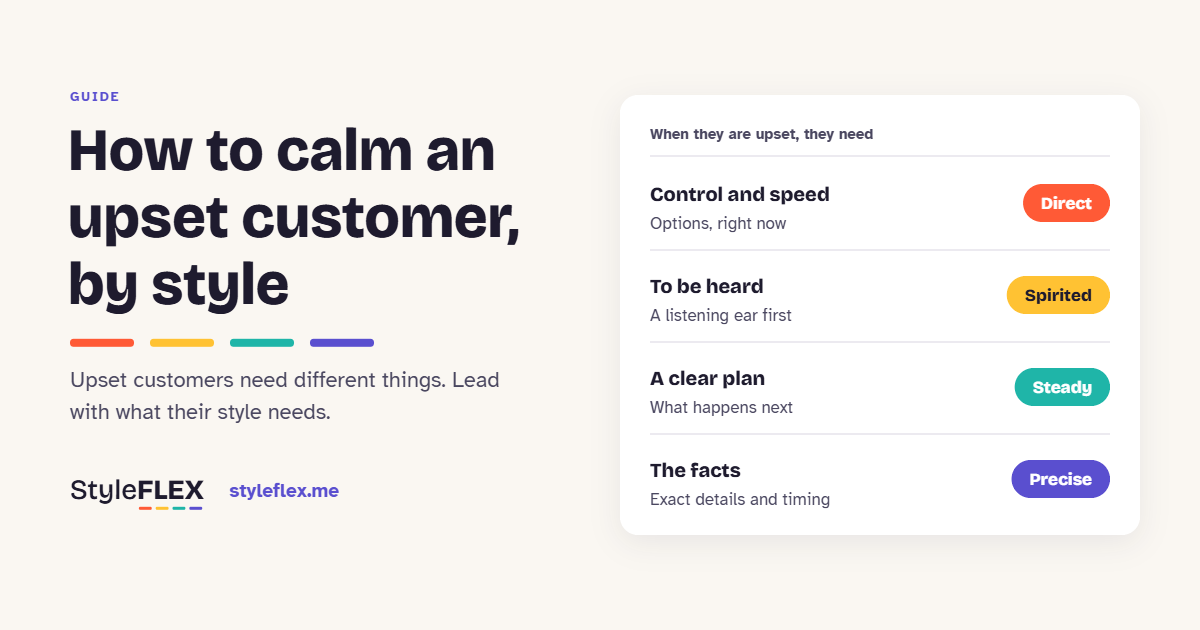
Most de-escalation training teaches one approach: stay calm, apologize, show empathy, solve the problem. It's good advice, and it works on some customers. On others it makes things worse. A long apology frustrates someone who wants the fix now. A quick fix feels dismissive to someone who needs to be heard first.
Upset customers are under stress, and stress pushes people further into the style they lead with. So the fastest way to calm someone down is to give them what their style needs most.
What each style needs when they're upset
| If they lead with | Under stress they sound | What they need | Say something like | Avoid |
|---|---|---|---|---|
| Direct | Short, blunt, demanding, may interrupt | Control and speed | "Here's what I can do right now. Which works for you?" | Long apologies, process explanations, "I understand how you feel" |
| Spirited | Loud, emotional, tells the whole story | To be heard and to feel you're on their side | "That sounds really frustrating. Tell me what happened." | Cutting them off, a flat or canned tone |
| Steady | Quiet, hurt, may say "it's fine" when it isn't | Reassurance and a clear plan | "I'll take care of this. Here's exactly what happens next." | Rushing them, surprises, vague promises |
| Precise | Cold, exact, cites dates and details, wants proof | Accuracy and accountability | "You're right. On March 3 we did X. Here's how we'll fix it and when." | Guessing, generalizing, emotional language |
The fix, the policy and the facts stay the same. What changes is what you lead with.
Three steps on any call or chat
- Listen for the first 15 seconds. Fast and blunt, loud and personal, quiet and hesitant, or cold and exact. Make a guess.
- Lead with what that style needs. Options for Direct, a listening ear for Spirited, a plan for Steady, the facts for Precise.
- Watch the reaction and adjust. If they get more frustrated, try a different opening. Calm is the signal you got it right.
Your style matters too
When you're under pressure, you slide into your own style. A Direct rep rushes a Steady customer. A Precise rep answers a Spirited customer's story with policy. Knowing the style you lead with tells you which customers you're most likely to make more upset without meaning to.
Closing
Calming someone down isn't about a better apology. It's about giving them what they need, in the way they need it, which lowers their stress and makes the fix land.
StyleFLEX helps service teams learn the style each person leads with and how to flex toward customers. Take the assessment at styleflex.me.
Related: The risk of not flexing in sales, The risk of not flexing with key accounts, The risk of not flexing in customer service