How to read a customer's communication style from one email
By Luke Williams · October 6, 2026 · 5 minute read
Most customer relationships start in writing. Before the first call, you usually have an email: a request, a question, a complaint, a reply to your proposal.
That email tells you more than what the customer wants. It shows how they like to communicate. Some people want the answer in two lines. Others want to know you understand their situation before you get to the plan. Send the wrong version and the facts can be right while the reply still lands badly.
You don't need a personality test to see the difference. You need to look for two things.
1. Pace: brisk or deliberate?
Pace is how fast someone moves toward a decision.
- Leans brisk: short, often a few lines. The decision or request comes first. Few questions, or one direct one. Wants a reply today.
- Leans deliberate: longer and complete. Context comes first, the request later. Several questions to think through. Mentions time to review or check with others.
2. Focus: tasks or people?
Focus is what someone pays attention to first.
- Leans task: opens with the point, the numbers or the date. Talks about results, specs and deadlines. Signs off with a name, or nothing. ("Can you confirm the go-live date?")
- Leans people: opens with a greeting or how things are going. Talks about the team, the users, who is affected. Signs off warmly. ("How is everyone on your side holding up?")
Put them together
Pace and focus give you four combinations. Each one points to what will make your reply easier to hear.
- Brisk and task-focused (Direct). Lead with the answer or the outcome. Keep it short. Give options and let them choose.
- Brisk and people-focused (Spirited). Start with a warm line. Share the bigger picture and what it means for them. Offer to talk it through, then follow up in writing.
- Deliberate and people-focused (Steady). Give them notice and a clear plan, step by step. Say who it affects and how you'll support them. Don't push for a decision on the spot.
- Deliberate and task-focused (Precise). Send the details: dates, numbers, what changed and why. Attach the evidence. Give them time to review before you ask for a decision.
None of these is better than another. Most people use all four. The email shows you which one they're leading with right now.
An example
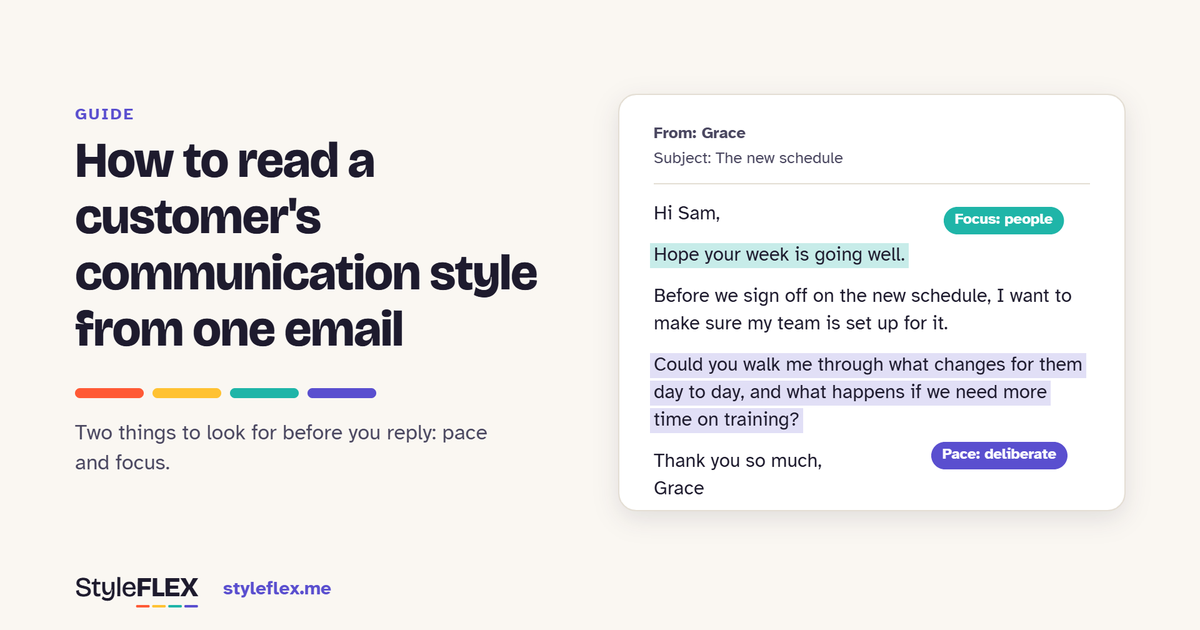
Here's an email from a (made-up) customer:
Hi Sam,
Hope your week is going well. Before we sign off on the new schedule, I want to make sure my team is set up for it. A few of them are nervous about the switch, and two are out the week of the 14th.
Could you walk me through what changes for them day to day, and what happens if we need more time on training?
Thank you so much, Grace
The read. It opens warmly and talks about her team before the task: leans people. It's complete, asks questions to think through and doesn't rush a decision: leans deliberate. Deliberate and people-focused points to Steady.
A reply that misses:
Grace, the schedule is final and training is 2 hours. Can you sign by Friday?
It's accurate. It's also likely to make her more nervous, because it skips her team and pushes for a decision.
A reply that lands:
Hi Grace, thank you for checking before you sign. Here's what changes for your team, step by step, with dates. For the two people out on the 14th, we can run a catch-up session the following week. If you need more time on training, we can move the start date by a week without changing anything else. Happy to walk your team through it on a call.
Both replies give the same facts. The second one gives her notice, a plan and room to decide.
Before you rely on it
One email is one clue, not a conclusion. A few things to keep in mind:
- The situation shapes the writing. A procurement request is short and task-focused because of what it is, not because of who wrote it. Someone writing from their phone between meetings looks brisk. Look at more than one message before you decide.
- Stress changes style. People under pressure often get shorter and more direct than usual. If a normally warm customer sends a terse email, something may be wrong.
- Treat it as an assumption. Write it down, then check it against the next email, call or meeting. Each one adds a clue, and the picture gets clearer.
- It's about how you communicate, nothing else. Use what you notice to make your message easier to hear. Not to judge, rank or label the person.
Try it on your next email
Before you reply to a customer this week, take ten seconds:
- Brisk or deliberate?
- Task or people?
- What would make this easier for them to hear?
Then write the reply that fits them.