We're all improving how we talk to AI. Let's improve how we talk to each other.
By Luke Williams · October 8, 2026 · 5 minute read
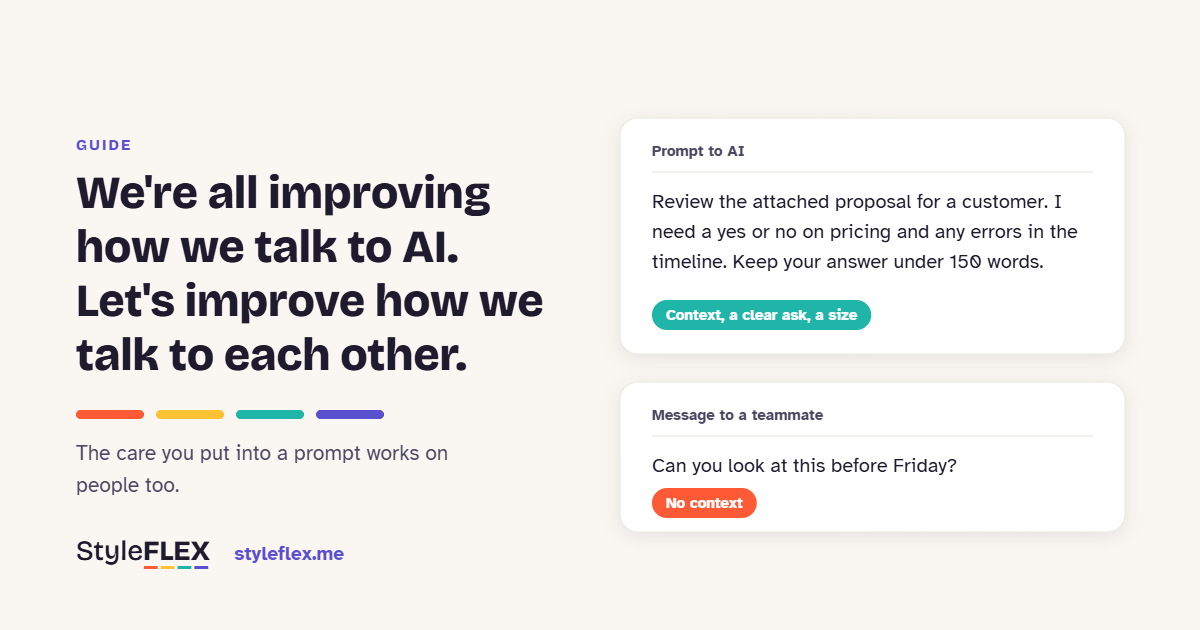
Most of us learned something new this year: how to talk to AI. We give it context. We say who the output is for. We ask for a format and a length. When the answer misses, we rewrite the prompt and try again.
Then we send a coworker "can you look at this?" and wonder why it comes back wrong, late, or with a tone we didn't expect.
A lot of training right now is about how people talk to AI. StyleFLEX is about how people talk to each other. The good news is you've already been practicing.
What you already do for AI
A good prompt does four things:
- Gives context. What this is, why it matters, what's already been decided.
- Says what you want back. A yes or no, a list of problems, a rewrite, a decision.
- Sets the size. "Two sentences" or "a full plan," so the effort matches the need.
- Gets adjusted when it misses. You don't blame the tool. You change how you asked.
Every one of these works on people. Most messages to coworkers skip all four.
What people need that AI doesn't
AI reads every message the same way, at any hour, in any mood. People don't.
- People have a pace. Some want the answer in two lines. Others want time and the full picture before they decide.
- People have a focus. Some read for the task: the date, the number, the next step. Others read for the people: who's affected, how everyone's doing.
- People get stressed. The same message reads differently to someone who's rushed, behind or worried.
- People remember. How your last message felt shapes how they read the next one.
That's the part a prompt never has to handle, and it's where most workplace friction starts.
Adjusting for the person
StyleFLEX groups those differences into four styles. Everyone uses all four. Each person tends to lead with one, and it tells you what makes a message easier for them to hear.
- Direct (brisk, task-focused): lead with the outcome. Offer options, not a single path. Keep it short.
- Spirited (brisk, people-focused): start with a little connection. Share the bigger picture first, then follow up with the details in writing.
- Steady (deliberate, people-focused): give a heads-up and a clear plan. Ask for their view directly. Give them time to decide.
- Precise (deliberate, task-focused): send the details ahead of time. Give them time to think. Ask specific questions.
One request, three ways
You need a teammate to review a proposal for a (made-up) customer before it goes out.
The quick version:
"Can you look at this before Friday?"
No context, no clear ask, no sense of how long it takes. This is the message you'd never send to an AI tool.
The prompt-quality version:
"Can you review the attached Hendrix proposal by Friday at noon? I need two things: a yes or no on the pricing section, and any errors in the timeline. It should take about 15 minutes."
Much better. Clear context, a clear ask, a size. For a Direct or Precise teammate, this is close to perfect.
Adjusted for a Steady teammate:
"Heads-up: I'd like your eyes on the Hendrix proposal before it goes out Monday. Could you review it by Friday at noon? Mainly the pricing section and the timeline. If anything in the rollout plan worries you for the support team, tell me. That's the part I most want your view on."
Same request. It adds notice, the reason, and a direct invitation to raise concerns, which is what a Steady teammate needs before they'll say what they really think.
Before you send something that matters
Take 30 seconds and ask:
- Who is reading this, and what do they need first: the answer, the reason, or the plan?
- Do they want it short, or complete?
- What will they be wondering when they finish reading?
- What would make this easier for them to hear?
Try it this week
Pick one message you'd normally fire off in a line. Give it the same care you'd give a prompt, then adjust it for the person reading it. Notice what comes back.